- hello@cenavis.com
- +34 (673) 585-607



M/Y URSUS ⇒ M/Y Ursus 2
The Story Behind It: M/Y Ursus Becomes M/Y URSUS 2
The Story Behind It: M/Y Ursus Becomes M/Y URSUS 2
- Original builder: Acico Yachts (2013 - 2015)
- Refit yard/management: Balk Shipyard (2022 - 2025)
- Naval architect: Mulder Design (2022)
- Build Captain: Eric P. Stammel (Since 2019 ⇒)
- Owners`s Rep.: Eric P. Stammel (Since 2019 ⇒)
Some yachts are built, launched, and begin their lives at sea.
And then there are vessels like Ursus.
Her story is not just about steel, machinery, and design. It is about a vision that nearly shattered against reality. About technical setbacks, wrong decisions, and a moment when a yacht practically lost its purpose. But above all, it is about people who refused to let this story end in failure.
The story begins on August 11, 2013.
On that day, the keel of a new explorer yacht was laid in the Netherlands. Under the designation Bandido 80, an extraordinary yacht was to be built at the ACICO shipyard in Enkhuizen: around 24 metres long, with a diesel-electric azipod propulsion system that was unusual for a project of this kind.
It was the beginning of a dream. But before long, that dream became a project that would remain with its owners for many years.
The First Warning Sign
When the yacht was finally launched, something became apparent that no glossy rendering could conceal: Ursus was sitting noticeably too low at the bow. The first sea trials revealed an even more serious problem. The vessel could not reliably maintain its course. Attempts were made to correct the problem—in the most literal sense. The bow was modified. Additional fins were welded onto the stern. Lead ballast was repeatedly repositioned inside the vessel, and at one point even the keel was filled with lead. Yet every measure added more weight without truly solving the underlying problem. For the owners, it must have been a sobering sight: a yacht that was supposed to be finished was lifted out of the water again. Welding resumed on an already painted hull. And still, the hoped-for improvement failed to materialise.
Then came the next blow.
The original shipyard became insolvent. Eventually, Balk Shipyard in Urk took over the task of continuing work on Ursus and at least completing the outstanding items. At the time, nobody could have known just how important this shipyard would become years later in the second life of Ursus.
A Vessel Full of Compromises
Ursus incorporated some extraordinary ideas. But several of them proved far less convincing at sea than they had on paper. The anchoring arrangement was a good example. The anchor was positioned behind a hatch in the bow. When deployed, it was intended first to travel along the stem before dropping into the sea. During its very first use in rough conditions, the hatch was torn off.
The garage forward of the bridge was equally unusual: a jet ski below, the tender above it and the associated crane also positioned far forward, despite the vessel already carrying too much weight at the bow. Even the beach club presented its own problems. Its large platform sat only around twenty centimetres above the waterline. At anchor, waves could strike the underside of the platform with considerable force. It was a lesson that would run through the entire story of the first Ursus:
Good design must do more than look good. It has to work at sea.
2018 - A Look Behind the Scenes
In 2018, a new phase began.
At that point, Ursus was at Balk in Urk. It now became clear that the difficulties extended far beyond the hull. Electrical and electronic systems, air conditioning, lighting, navigation, stabilisers, the gangway, and eventually the propulsion system were all affected.
Analysis of the electronic systems revealed fundamental errors from missing termination resistors and incorrectly used protocol converters to incorrect baud rates.
The propulsion system was particularly critical.
Ursus was equipped with a complex, project-specific azipod solution combining components from several different manufacturers. An architecture like this, however, requires overarching technical coordination: someone has to take responsibility for ensuring that many individually functioning components ultimately form one functioning overall system. This was precisely where one of the project`s fundamental risks lay.
Following further modifications to the hull, another series of sea trials took place on the IJsselmeer. The result was sobering.
Eight knots.
Around twelve had been expected.
At least Ursus was now running straight. But a conspicuous noise emerged from the stern area. Eventually, the suspicion was confirmed: propeller cavitation. In response, the azipods were rotated by 180 degrees and converted from a push to a pull configuration. This required new propellers as well as modifications to the software, autopilot, and dynamic positioning system. Nobody yet knew that the most difficult moment in the yacht’s history was still to come.
Mallorca - Finally Arrived
In May 2019, almost six years after her keel had been laid, Ursus finally reached Mallorca. After ACICO, Balk, years of delays, and periods spent in Bremerhaven, she was transported by ship to Alcúdia and subsequently moved to Club de Mar. For the first time, she was where she should have been long before.
It was a moment of relief.
Technically, the yacht was still nowhere near the level originally envisioned. But after all those years, something else mattered more: She was finally there.
The owners took her on a weekend trip to Ibiza. It was meant to be the reward for six years of patience. It became the first and only proper voyage Ursus would make in this form.
Once again, she barely managed more than eight knots. In following seas, the stern behaved unusually. Then, suddenly, one of the azipods swung approximately 45 degrees out of position. Ursus returned safely to port.
But confidence in the vessel had been shaken.
Two Minutes That Changed Everything
In December 2019, by which time I was already actively involved, Ursus was due to be taken to Barcelona for routine shipyard work. There were three of us on board. The route took us from Palma via Andratx, then between Sant Elm and Dragonera and out towards Barcelona.
Then the alarms started.
- Temperature warning on the port azipod.
- Temperature warning on the starboard azipod.
- Water ingress in the port azipod.
- Water ingress in the starboard azipod.
Within a very short time, the entire propulsion system had failed.
With the help of the bow thruster, the crew managed to keep Ursus reasonably under control. Eventually, one pod could be reactivated. The yacht turned around and limped back to Palma at approximately five knots, where an emergency haul-out was arranged. But the true extent of the disaster only became apparent once she was ashore. Both azipods were full of water. They were effectively a total loss.
There were no remaining warranty claims, the original shipyard no longer existed, and according to the account in the underlying document, the insurance did not cover the costs. At the same time, the old problem remained: the hull allowed a speed of only around eight knots.
After six years, Ursus was back on land. Without a functioning main propulsion system. With a hull whose performance fell far short of the original expectations. It was the moment when giving up would have been understandable.
An Ending Becomes a Beginning
Then came COVID.
As difficult as that period was in every other respect, for Ursus the standstill provided something that was desperately needed: Time.And time to ask one fundamental question:
- Time to analyse.
- Time to plan.
Do we repair this vessel yet again or do we rethink it completely?
iYacht, under naval architect Udo A. Hafner, had previously developed concepts for extending Ursus. After the catastrophe of 2019, it became increasingly clear that a fundamental transformation might offer the most sustainable solution. The damaged pods were removed. According to the document, their scrap value was less than € 2,000. After around six months at STP Mallorca, Ursus was towed to Barcelona. The major conversion was originally intended to take place there. Ultimately, however, a decision was made that would prove decisive:Ursus would return to Urk. To Balk Shipyard.
She arrived there in December 2022:With the temperature inside the cabins at five degrees Celsius.
- In the middle of the night.
- Without a generator.
- Without heating.
It was not a glamorous beginning.
But it was the beginning of her second life.
The Birth of Ursus 2
At first, nobody knew exactly how far the conversion would go. Documentation from the past was missing or incomplete. Drawings, photographs, and 3D data had to be collected, reviewed, and reorganised. Suppliers had to be found and technical possibilities investigated. Then came the presentation that changed everything.
Previous concepts had focused primarily on extending the stern. But now a more radical idea emerged:
Why extend only the stern? Why not extend the bow as well? For the first time, the drawings showed the vessel that would later become Ursus 2. Four variants were ultimately presented. The owner chose design number 4.
Yet even then, the vision was not complete. The saloon and sun deck were to be extended by another metre. What had begun as a refit had definitively become a fundamental rebuild.
The Point of No Return
On July 17, 2023, the day came when plans became reality. The machinery moved in.
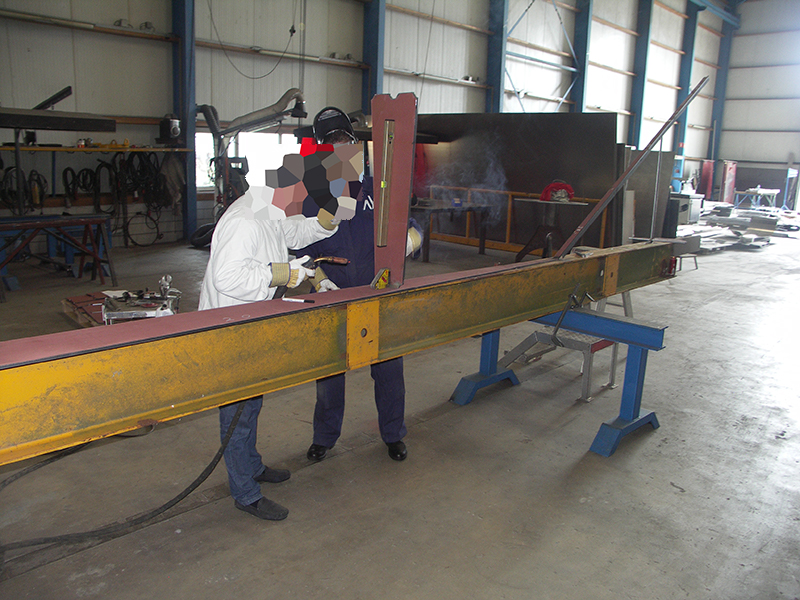
Ursus was cut apart.
Steel met steel. Sparks flew. Sections of a vessel that had been cared for and lived aboard for years were cut away. It was the moment when everyone involved in the project knew: There was no turning back now.
Additional specialists were brought in. New hull sections were fabricated. In February 2024, the sections were delivered and fitted the existing hull with remarkable precision. This time, as little as possible was to be left to chance. The hull work was voluntarily carried out under the supervision of Lloyd`s Register. Production stages were documented, critical connections inspected, and the work regularly checked. Technically, too, an almost entirely new vessel emerged.
Propulsion, electrical systems, navigation, communications, network infrastructure, monitoring, lighting, stabilisers, gangway, bridge, and flybridge were redesigned or extensively modified. Again and again, the project demonstrated why a refit of this scale can never be planned completely in advance. Behind a panel, you discover a structure nobody expected. One small modification suddenly triggers five more. Delivery times change. Materials become scarce. Prices rise. Ursus 2 therefore did not simply emerge according to a fixed plan. She emerged through a constant process of planning, checking, deciding and deciding again.
And What Colour Does a New Beginning Have?
Eventually, the steel was joined together again. Thirty metres of hull had to be filled, faired, sanded, and prepared for a paint finish that would later appear almost mirror-smooth. Then an entirely different question arose:
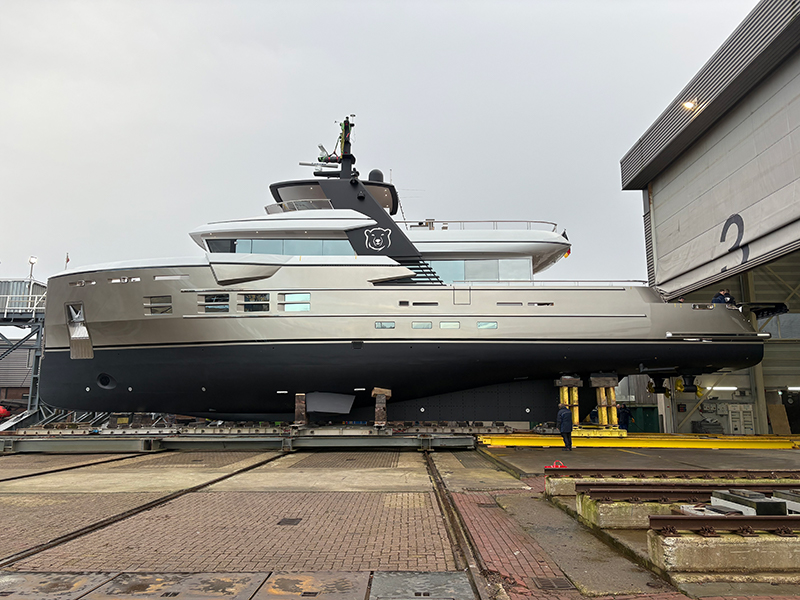
What should this new vessel look like? Mulder Design presented various colour schemes. The owner took his time. Fourteen days later, the decision was made:Depending on the light, the hull changes character from silver-grey through gold to a warm copper tone. The old Ursus had visibly become something new.
- Hull: Batumi Gold Metallic.
- Superstructure: White
- Side elements: Matt Black
January 9, 2025
Then came the morning so many people had worked towards.
Outside, it was cold.
The hall was silent.
Ursus 2 stood completed before her team.
No longer a drawing.
No longer a 3D model.
No longer a hull cut into pieces.
But a ship.
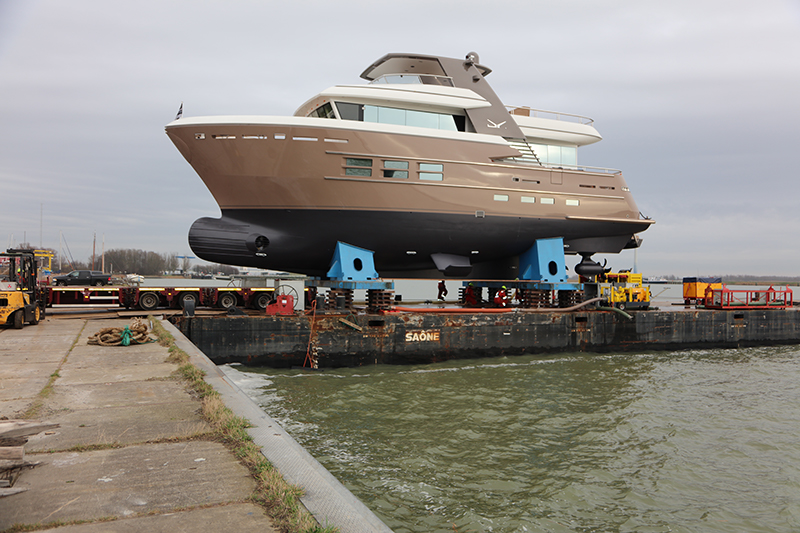
Slowly, she was moved into the water
And with her came the questions that, after a rebuild of this magnitude, nobody could completely suppress:
Will she sit correctly in the water?
Is everything watertight?
Will theory and reality finally agree this time?
Then the hull touched the water. Seconds passed. And finally came certainty. She sat level. Stable. Watertight. No unpleasant surprises.
After two years of intensive shipyard work, Ursus was afloat again.
The following day, January 10, 2025, she was christened by the owner and officially launched. This time, it was not a test. Ursus 2 was born. But a yacht does not prove itself inside a shipyard hall. It proves itself at sea. On February 7, 2025, the first sea trial began.
After everything that had happened with the original Ursus, this moment had to be special. Now it would become clear whether years of work had actually created what had originally been promised.
Cast off. Slowly, Ursus 2 began to move. The new pods responded. Smoothly. Precisely. Powerfully. Accelerating. Turning. Stopping. Counter-steering. Manoeuvre by manoeuvre, the tension began to fade. The vessel`s behaviour bore almost no resemblance to that of the old Ursus. After hours on the IJsselmeer, the yacht returned to Urk under full control. The lines were secured. The engines fell silent. The first sea trial had been a success.
Back to Mallorca
Further months of testing, optimisation, documentation, and bureaucracy followed. By now, Ursus 2 had also entered an entirely different regulatory world. While Ursus 1, at 23.89 metres, had remained below the 24-metre threshold, Ursus 2 now exceeded 30 metres. This brought new requirements relating to flag registration, insurance, IMO number, call sign, MMSI, and international regulations. Finally, one last important decision had to be made.
Should Ursus 2 sail to Mallorca under her own power?
Or should she be transported?
The decision was made to transport her.
On December 3, 2025, Ursus 2 was finally unloaded in Alcúdia. Because of the weather, even the final leg to Palma was anything but a leisurely victory cruise. Headwinds and uncomfortable seas forced the crew to take a different route.
At 11:30 p.m., the lines were secured.
Engines off.
Silence.
Ursus Was Back in Mallorca
This time, however, as a different vessel.
Born Twice
More than twelve years separate the laying of the keel in August 2013 from the arrival of Ursus 2 in Mallorca in December 2025
Years filled with hope and wrong decisions.
Shipyard insolvency.
Technical problems.
Countless modifications.
A first yacht that never truly achieved the performance it had been promised.
A catastrophic failure of both propulsion units.
COVID.
Years ashore.
And finally, perhaps the most unusual decision of all: Not to give up.
That is why the story of Ursus is more than the story of a yacht refit. It demonstrates just how far vision and reality can diverge in yacht building. It shows how costly a lack of overall technical responsibility can become. And it demonstrates why planning, experience, communication, and trust are at least as important in a project of this magnitude as steel and machinery. But above all, it is a story about people.
About owners who held on to their vision despite every setback. About engineers, shipyards, technicians, designers, and craftspeople who transformed an almost failed project into a new vessel.
And about a team that eventually stood before a yacht which, in this form, would probably never have existed without all those setbacks.
At the end of the underlying report, therefore, it is not technology that takes centre stage, but gratitude: gratitude for everything experienced together, for the trust that grew along the way, and for the pride of having created something meaningful together.
Perhaps that is the real story of Ursus
She was laid down in 2013.
But she was born twice.
Once as a dream.
And once from the decision not to give up on that dream.
Eric P. Stammel, Owners Rep. & Build Captain